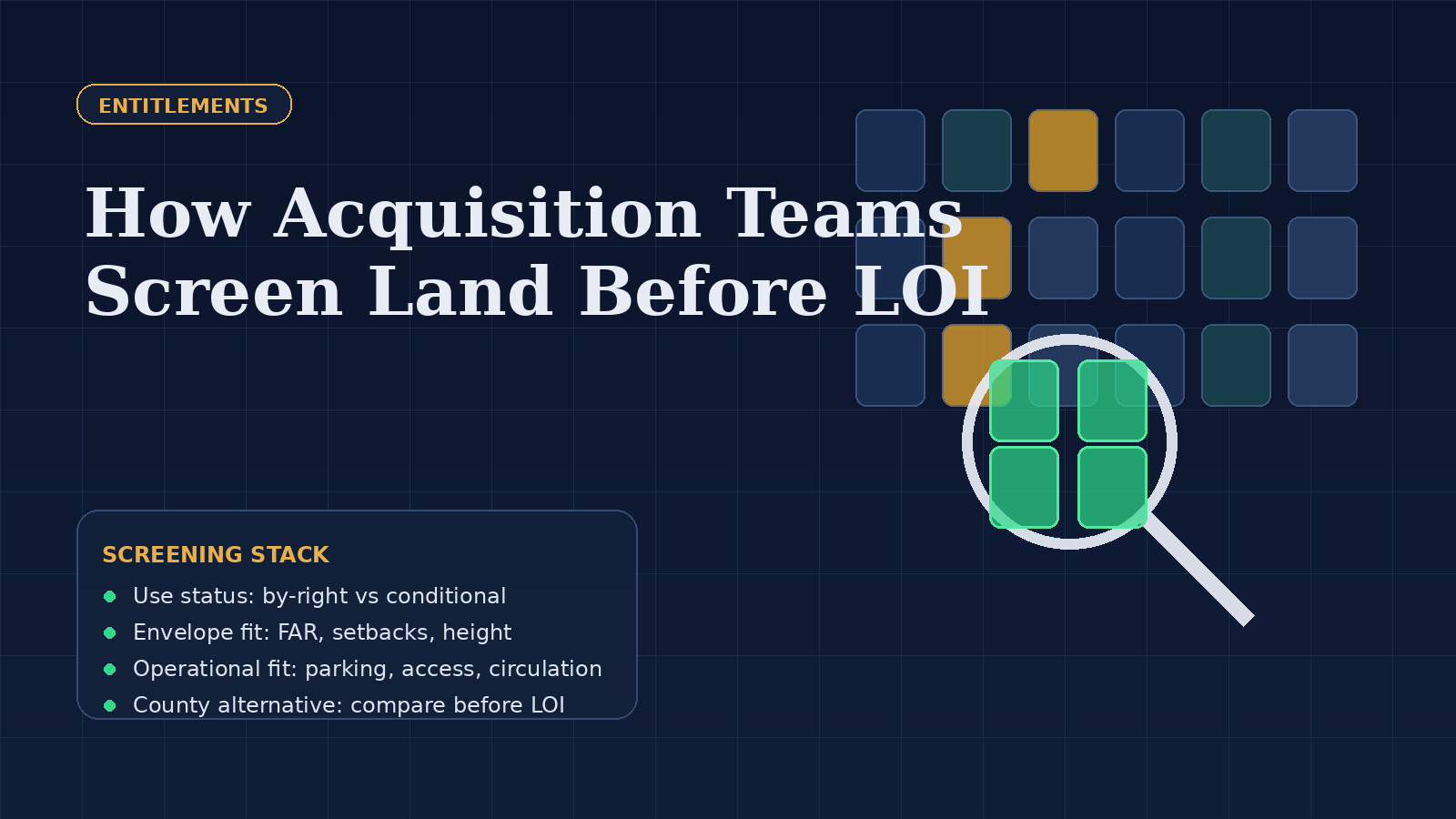
Most land teams do not lose money because they cannot find parcels. They lose money because they move too far into a site before answering a much smaller question: is this site even directionally viable for the intended use?
That is the gap zoning intelligence should close. Before a broker call, before a design sketch, before a legal memo, the acquisition team should already know whether the site is likely by-right, likely conditional, or likely dead on arrival.
What should be answered before LOI
The pre-LOI stage is not about perfect certainty. It is about filtering quickly and consistently. For most retail, QSR, industrial, self-storage, and mixed-use land searches, the first pass should answer five things:
- Is the intended use permitted by-right, conditional, or prohibited?
- Do the basic dimensional controls support the business plan?
- Is parking or circulation likely to be the hidden constraint?
- Is there an overlay, jurisdiction split, or approval path that changes the risk?
- How does this county compare with realistic alternatives in the same search?
A fast screening sequence
A strong acquisition workflow usually looks like this:
- Search the county and zone to identify the likely district or comparable district.
- Confirm the use classification and separate by-right uses from conditional ones.
- Check FAR, lot coverage, height, setbacks, frontage, and minimum lot thresholds.
- Run parking and drive-thru feasibility if the deal depends on those economics.
- Compare the site against one or two backup jurisdictions before escalating.
This step sequence matters because teams often jump straight from parcel interest to broker discussion. That sounds fast, but it usually creates noise. A broker conversation is more productive when the team already knows the likely zone family, approval friction, and the top constraints that could kill the deal.
What acquisition teams often miss
The most common mistake is treating a zoning label as the answer. A district called General Commercial may appear friendly, but that label alone does not tell you whether a drive-thru is conditional, whether parking ratios make the building size unrealistic, or whether access standards will undermine the site plan.
Another frequent miss is assuming county naming is transferable. One market’s C-2 is not another market’s C-2. The name may feel familiar, but the economic envelope is defined by the underlying standards, not the code label.
How ByRightHQ fits into the process
ByRightHQ is most useful when it becomes the first operating layer for screening. The platform helps teams move from “this parcel sounds promising” to a more structured decision:
- Can we pursue this as a by-right path?
- If not, is the conditional path still worth the friction?
- What is the likely buildable envelope?
- Which backup counties should we test next?
That is not legal sign-off. It is a better underwriting start point.
A simple internal scorecard
Teams that move fast often standardize a lightweight scorecard before LOI. One example:
- Use status: by-right, conditional, or prohibited
- Envelope fit: does FAR, coverage, and height support the target program?
- Access fit: is ingress, stacking, frontage, or truck movement likely to break the concept?
- Approval risk: administrative, public hearing, or uncertain
- Market alternative: is there a comparable county with lower friction?
Even a simple scorecard creates discipline. It prevents teams from over-weighting location or broker enthusiasm while under-weighting entitlement reality.
When to escalate beyond screening
Once a site clears the first pass, then the next spend is justified. That may mean local broker outreach, land use counsel, civil review, or municipal confirmation. The point is not to avoid experts. The point is to send experts cleaner questions.
If you are still asking broad exploratory questions after LOI, the process started too late.
Takeaway
The best acquisition teams are not guessing faster. They are filtering faster. Zoning intelligence is most valuable before commitment, when it can reduce noise, sharpen broker outreach, and protect the team from spending real time on the wrong parcel.